


Social selling is creating a battle between Sales and Marketing.
The same activity can build awareness, create trust, start conversations, and influence the pipeline. Which means both teams have a reason to claim ownership.
Should it sit with Sales because it drives revenue, or with Marketing because it relies on content and brand? Or should both teams share the responsibility?
This is usually the point where companies end up in a meeting that nobody wins because the answer is not straightforward.
Why This Question Keeps Coming Up
Social selling breaks the traditional mechanics of a B2B organization for three specific reasons.
It ignores the funnel.
For decades, the standard model was linear where marketing creates demand and sales converts it. Social selling completely breaks this conveyor belt. When a rep publishes a post, a buyer reads it, trust builds, a conversation starts, and a meeting gets booked all within a single feed. The same activity creates awareness and captures pipeline simultaneously.
Buyers do not care about your org chart.
Internally, we draw hard boxes around departments like marketing, sales, and customer success. But buyers experience one brand and one continuous buying journey. A prospect does not care whether their trust came from a corporate webinar, a founder post, or a sales rep commenting on an industry thread. They just remember who they know and trust.
Neither team knows how to measure it.
Marketing teams live and die by awareness metrics like impressions, engagement, and reach. Sales teams live and die by volume metrics like meetings, opportunities, and closed revenue. Social selling creates outcomes that sit awkwardly in the middle like familiarity, trust, and preference. Because these signals do not fit neatly into either department's existing analytics dashboard, neither side knows how to measure or claim its ROI.
The Core Dilemma: Three Broken Approaches
When companies try to force social selling into traditional departmental buckets, the same failure modes appear every time.
The Sales Led Model:
The argument here is that sales owns relationships and carries the quota, so they should own the channel. When sales leads the charge, pipeline focus is high and buyer conversations happen faster. But adoption is almost always uneven because it relies on a few naturally motivated reps. Content quality varies, posting becomes inconsistent, and the moment the quarter gets busy, social selling is discarded to chase immediate numbers.
The Marketing Led Model:
The logic here is that marketing already owns messaging, brand assets, and content distribution. When marketing runs the program, content is polished and consistent. But the connection to hard revenue quickly weakens. Sales reps disengage because it feels like a corporate mandate rather than a live sales tool. The program starts optimizing for vanity metrics like likes and impressions, resulting in beautiful posts but empty calendars.
The Shared Ownership Model:
To avoid a turf war, many companies opt for a blended approach where marketing supplies the content and sales manages the relationships. On paper, it makes sense. In reality, when something belongs to everyone, it belongs to nobody. Accountability blurs, momentum slows down as reps wait for brand approvals, and the initiative quietly falls through the organizational cracks.
The Real Shift: It’s an Operational Capability
The companies achieving repeatable revenue from social media are not debating ownership. They are changing how their teams operate entirely.
Look at Gong.
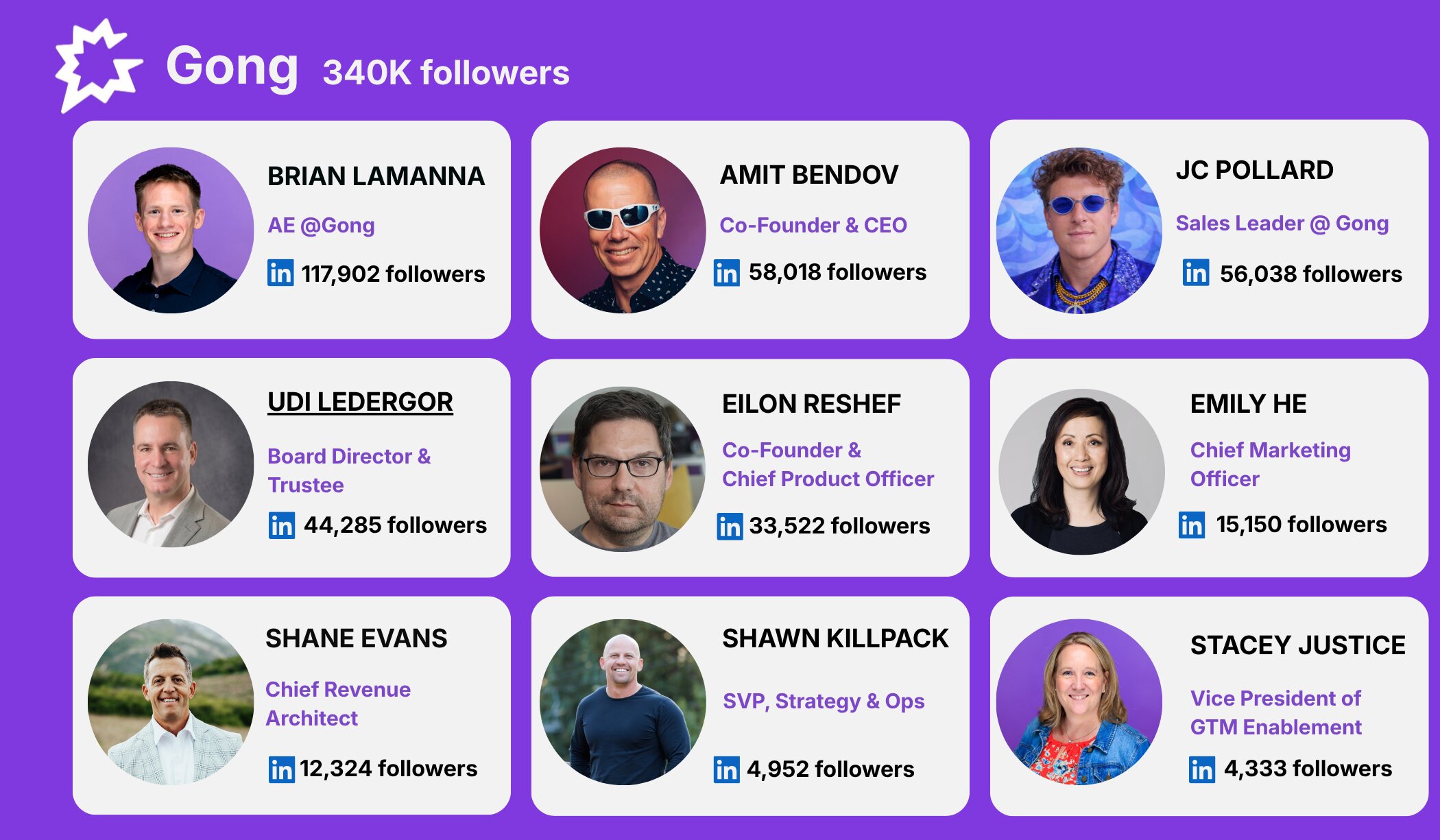
Their public presence is not confined to a single department. Executives, product managers, marketers, and account executives all post actively. Social selling is treated as a company wide capability rather than a tactical task assigned to one team.
This is why social selling is naturally moving toward revenue operations and revenue enablement teams. These teams exist specifically because revenue operations cross departmental boundaries, providing the infrastructure, content activation, and tracking required to turn social activity into a predictable pipeline.
How to manage social selling as one pipeline engine
The fundamental truth is that the argument is not about sales versus marketing.
It is about trust creation.
Marketing historically owned attention and sales historically owned relationships.
Social selling fuses both.
No single department has ever owned trust creation as an isolated business process, which is why the traditional framework fails.
This is why we developed the Social Led Growth methodology at Linkbound.
We treat the collective LinkedIn presence of your team as a unified pipeline engine, managed via a clear four stage system.
- Activate: Equip the revenue team with tailored content direction based on their roles so nobody faces a blank page.
- Attract: Deploy intent driven content that draws your ideal customer profile into the feed naturally.
- Identify: Track and score every engagement across every employee post against your target account list so warm interest is never missed.
- Convert: Transition those warm social touchpoints into active sales pipelines with full context.
Ultimately, asking who owns social selling will soon sound just as outdated as asking who owns the CRM. Everyone uses it, everyone contributes data to it, and no single department can make it work in isolation.
Where to Go From Here
If your social selling initiative is currently stalling, it is an architectural problem rather than a motivation problem. Stop trying to force a cross functional buyer journey into a siloed company structure.
If you want to move past the internal debate and see how to systematically turn your team's LinkedIn activity into measurable revenue, book a 20 minute call with us.
We will look at your team's current footprint, pinpoint where your data gaps are, and show you where your pipeline opportunity is hiding.
Frequently Asked Questions
Who should run social selling?
No single department can execute it alone. While sales drives the conversations and marketing supports the messaging, the ultimate operational tracking and enablement are best handled by cross functional teams like revenue operations.
Is social selling a marketing tactic or a sales activity?
It is a hybrid motion. It uses marketing principles like content and brand positioning to achieve a distinct sales outcome like pipeline, meetings, and revenue.
Why do shared ownership approaches usually fail?
Because shared often turns into a lack of accountability. Without explicit systems to provide content direction, tracking software to score leads, and clear pipeline visibility, execution relies on guesswork and eventually stops.
Does team social selling require hiring new roles?
Not necessarily, but the rapid rise of dedicated employee advocacy managers and revenue enablement specialists shows that market leaders are investing in dedicated resources to manage this engine.


