


Your buyers are on LinkedIn right now. They're reading posts from founders and practitioners in their space, forming opinions about who understands their problems and who doesn't. Some of them will eventually need exactly what you sell.
Most B2B companies have no presence in that conversation. They're waiting for a meeting request that may never come, or sending cold outreach to people who have already decided how much attention to give it.
Social selling is the practice of being part of that conversation before the meeting ever starts.
This article covers what it is, why the underlying mechanism works, and what a basic starting framework looks like.
It's the first in a series on building Social-Led Growth into a pipeline system.
Why the Timing of This Matters
Cold outreach used to work well enough. Reply rates were low, but the math held up with enough volume and a reasonable sequence. That math has changed.
Cold email reply rates have dropped sharply over the past five years. [SOURCE] LinkedIn automation is getting accounts flagged, and cold calls connect at a fraction of the rate they did a decade ago.
The standard response from most sales teams is to increase volume, but more messages into the same broken channel produces more ignored messages, not more pipeline.
The issue isn't bad copy. It's a structural shift in how buyers research and evaluate vendors.
B2B buyers now complete a significant portion of their purchase evaluation before they contact a vendor. They read LinkedIn posts from founders in their space, follow companies that consistently share useful thinking, and form opinions about credibility and expertise long before a sales conversation starts. By the time they book a demo, many have already made a shortlist.
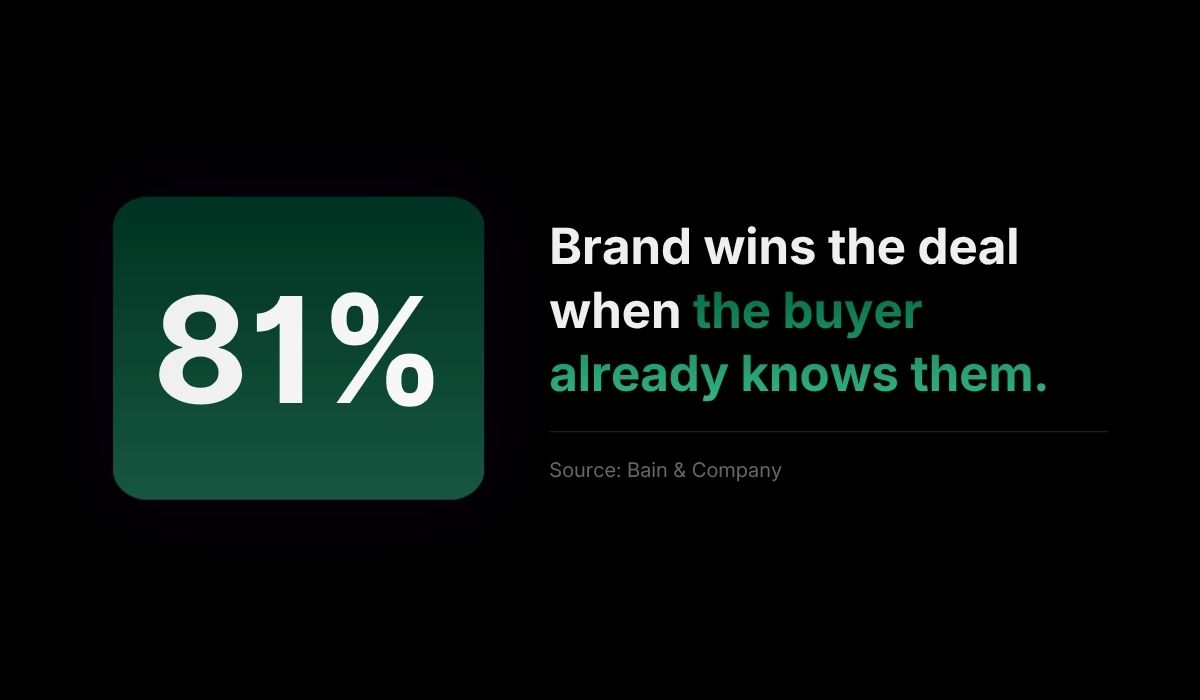
A Bain study found that when key stakeholders already know a brand before the purchase decision, that brand wins the deal 81% of the time. With no prior awareness, that number drops to 4%.
That gap between 81% and 4% is exactly where social selling operates.
What Social Selling Is
Social selling is the practice of building trust, familiarity, and credibility with your ideal customers in public, so that when they're ready to buy, you're already part of their consideration.
The core of it is simple: you consistently share useful thinking with the people you want to work with.
Content that reflects a genuine understanding of the problems your buyers face and the context they're operating in. Over time, that consistent presence creates something cold outreach cannot manufacture: you become a familiar and trusted voice before any commercial conversation has started.
The psychological mechanism behind this is well-documented. Repeated exposure to someone in a relevant context increases how positively people feel about them.
The practical result is that inbound leads from social are qualitatively different from cold-generated leads. By the time someone reaches out after following your content, they've already evaluated you to some degree. They're not asking whether you can help them. They're asking whether you're the right fit. Those conversations move faster and close at a higher rate.
Gary Vaynerchuk called it in his book Jab, Jab, Jab, Right Hook: give value consistently, ask only when you've earned it.
What Social Selling Is Not
Because the term gets used broadly, it's worth being specific about what doesn't qualify and why.
A connection request followed by a pitch.
This is just cold outreach with a different entry point. Social selling works because the buyer already has context about you before you reach out. A pitch right after connecting skips that entirely — there's no familiarity, no trust, no reason for the other person to respond differently than they would to any other unsolicited message.
Posting without a clear point of view or a specific audience.
Social selling creates association, over time, your ICP connects your name with a specific set of problems you understand. That only happens if your content is consistent and targeted. Random posting to no one in particular doesn't build that. It just adds noise to an already noisy feed.
Using automation to like posts, follow people, or send templated DMs.
Buyers at the level you're trying to reach have seen every version of this. It signals immediately that there's no real person behind the interaction, which is the opposite of what builds credibility.
Beyond that, LinkedIn actively restricts accounts running this kind of activity, so you risk losing the channel entirely.
Having someone ghostwrite your content while you stay disengaged.
The content might look right. But social selling depends on the relationship, not just the posts. When someone engages with something you've "written" and you're not there to respond, or when the follow-up conversation makes it obvious you weren't behind it, the trust collapses. You can't outsource the part that builds the relationship.
Why Social Selling Outperforms Cold Outreach
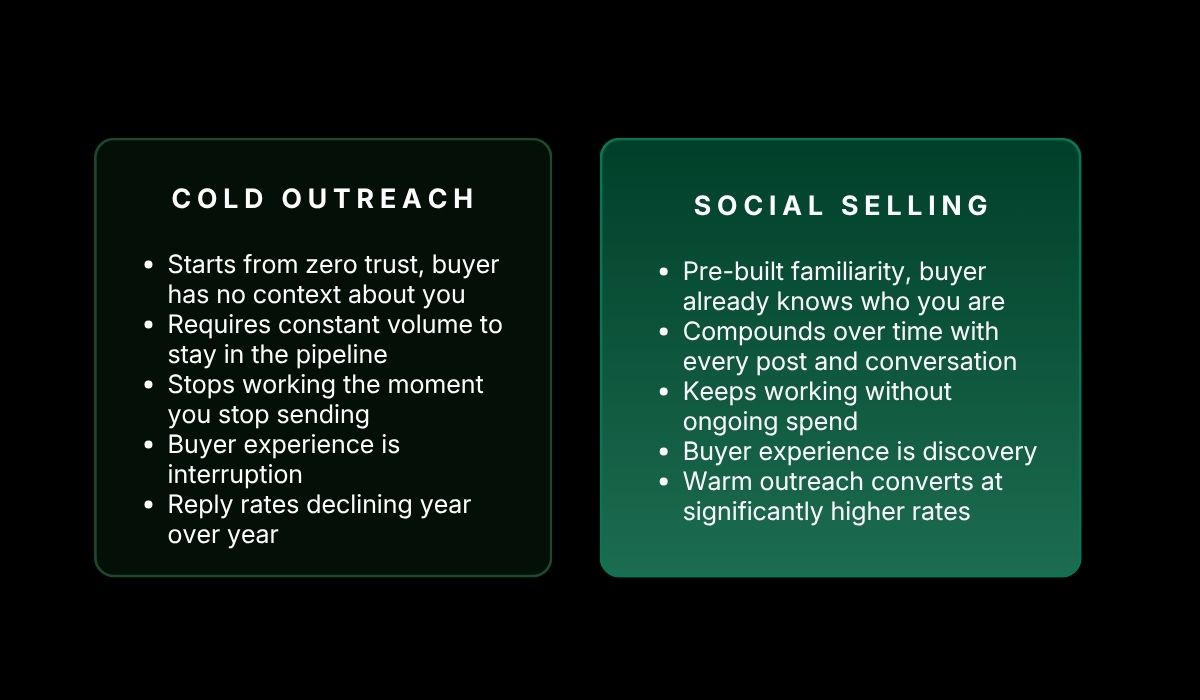
Cold outreach asks someone to trust you before they have any reason to. Even with good copy and a genuinely relevant offer, you're asking the buyer to override their default response to unsolicited contact.
That's a hard starting position, and most messages don't make it past it.
Social selling works differently because the trust gets built before you ever reach out.
When someone has seen your thinking across multiple posts over several months, they've already formed a view on whether you understand their world.
By the time you message them, you're not asking them to trust a stranger. You're following up on something they already have context for.
The message you send can be almost identical to a cold outreach message. What changes is everything the buyer brings to reading it.
We tested this at ZenDev before Linkbound existed. Same offer, same copy, two groups: people who had engaged with our content and people who hadn't. The response rate difference was significant enough that we stopped cold outreach almost entirely and rebuilt the whole sales motion around warm leads from LinkedIn.
The other thing worth understanding is the compounding effect. A post you published three months ago is still reaching new people today. A conversation you had in a comment thread last quarter might turn into a referral next year.
Cold outreach has no compounding quality at all.
The moment you stop sending, the pipeline dries up.
Social presence keeps generating attention even when you're not actively doing anything.
How to Start Social Selling: A 5-Step Framework
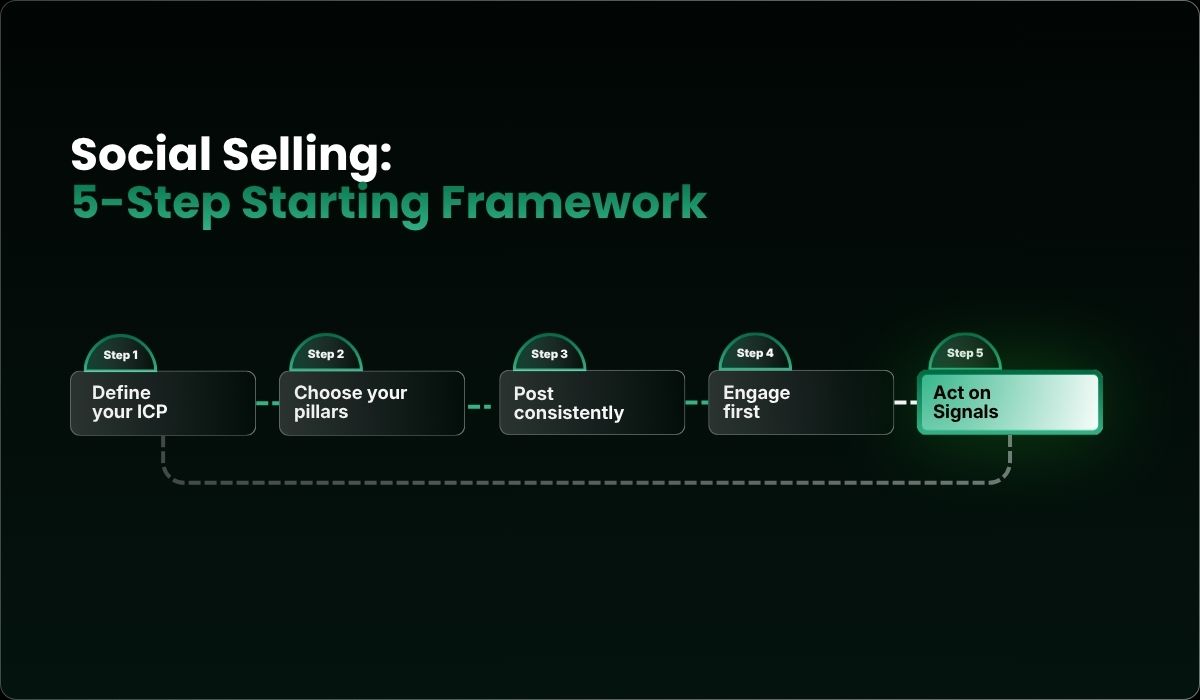
The foundation of a social selling motion fits into five parts.
Later articles in this series go deeper on each
1. Define who you're writing for by situation, not title.
Think about your five best customers.
What were they dealing with in the 90 days before they found you? That's the thing to write for.
A CFO managing runway after a missed quarter needs completely different content than a CFO who just closed a round. Same title, different moment.
Content written for a specific situation makes the right reader feel like you wrote it for them.
2. Only keep pillars that move your buyer closer to a decision.
For every topic you're considering, finish this sentence: "If my ICP believes [X], they're one step closer to buying from me." If you can't complete it, cut the topic. The goal isn't to be interesting. It's to be the first name that comes to mind when a specific problem comes up.
3. The first 60 minutes after posting matter more than the day you post.
LinkedIn uses the first hour to decide how far to push a post. Respond to every comment in that window, ask a follow-up question, keep the conversation going.
One more practical note: links in the post body get roughly 60% less reach. Put them in the first comment.
4. Spend more time commenting than posting.
Three to five substantive comments a day on posts your ICP reads does more than an extra post of your own. A comment that works: quote something specific from the post, add one thing they didn't say, ask one real question. "Great post" does nothing. Getting your name in your ICP's notification feed repeatedly, before you've ever reached out, is what makes a cold DM feel warm.
5. When your ICP engages with your content, reach out within 24 hours.
A like means monitor. A comment that reveals a real problem means act today.
The message is short: reference what they said, add one relevant observation, ask one question about their situation. Under 75 words. The goal of the first message is a reply, not a meeting.
From Individual Social Selling to Social-Led Growth
One founder doing this consistently will generate inbound and build pipeline. But something changes when more than one person inside a company does it.
Each additional person brings a different perspective and a different network. A sales rep speaks to different concerns than a founder. A head of product reaches technical buyers the founder never would. Multiple people from the same company appearing in a buyer's feed, with real perspectives from their actual work rather than company talking points, produces a different impression than any single voice can create.
At a certain point, this stops being social selling in the individual sense and starts being a company-wide growth motion.
That's what Social-Led Growth describes: not one person building a personal brand, but an organization systematically turning its collective LinkedIn presence into pipeline.
The content, the engagement, the warm lead identification, the outreach, and the pipeline tracking all connected into one system.
The rest of this series covers how to build that system.
This article is the entry point: understanding what social selling is, why it works, and where to start. The next piece goes deeper on the buyer behavior shift and what it means for how B2B companies need to think about pipeline generation going forward.
If you want to build this for your team, book a 20-minute call with one of our senior product marketing strategists. We'll look at your current LinkedIn presence and show you exactly where the pipeline opportunity already is.


